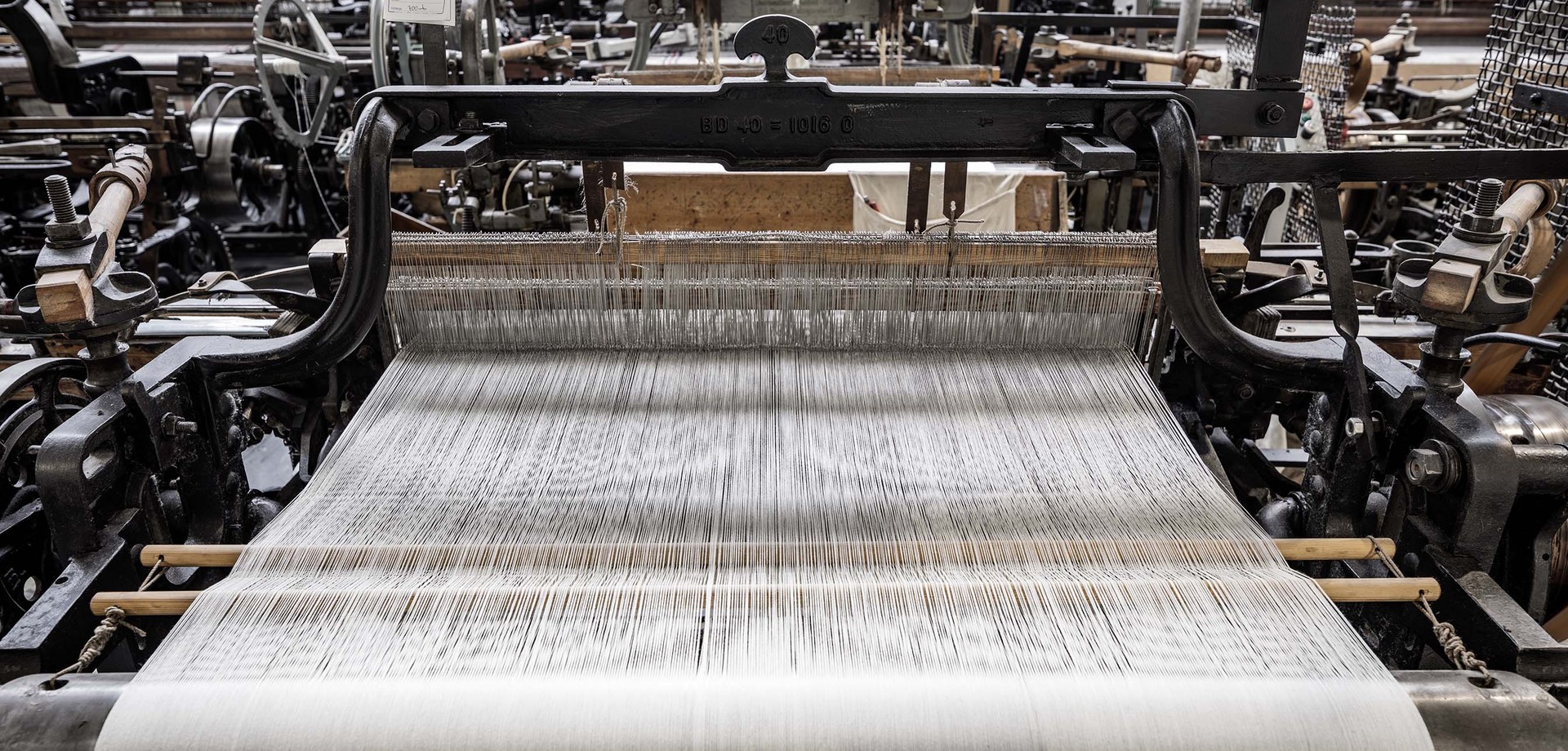
Weaving mill
From thread to finished fabric
The production hall of the textile mill’s weaving workshop is a replica of the old weaving hall at the Gebr. Essing weaving mill in Rhede. The company had commenced operations in 1891 with 50 looms and 25 weavers. When the company’s buildings were demolished in February 1985, the LWL Museum was able to salvage the cast-iron columns from the weaving hall dating from 1889–94, as well as other original fixtures.
Weaving room
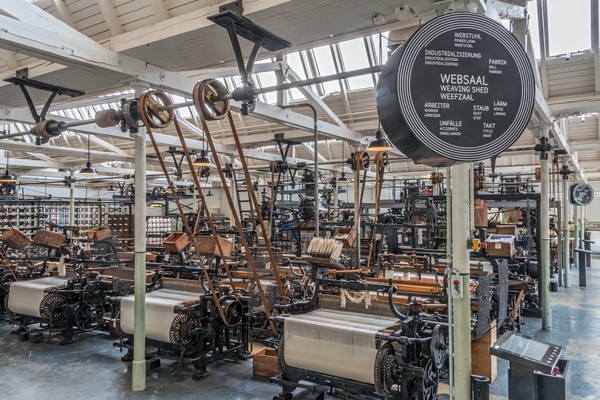
The weaving hall is a ‘shed hall’. Until the 1950s, such halls – with their characteristic sawtooth-shaped roof silhouette – were the typical architectural form for numerous factories. Their name derives from the arrangement of shed-like structural elements (English: ‘shed’). The large glass windows in the roofs are mostly north-facing. This ensures even lighting and prevents the building from overheating in the sun.
For today’s observer, it is difficult to imagine just how new and unfamiliar the factory complexes of the 19th century were to people at the time. The museum’s 32 looms give some idea of the scale of the vast workshops, with hundreds of looms lined up in rows.
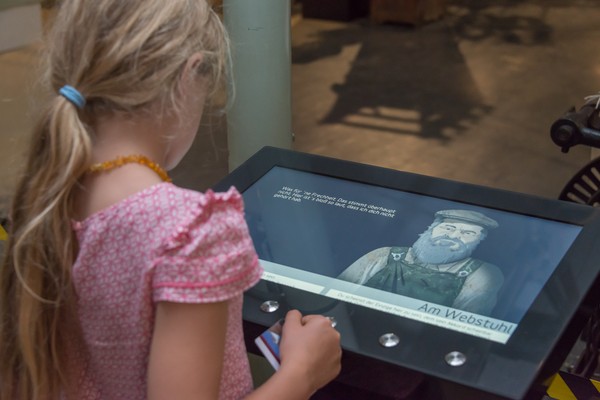
At 13 media terminals, visitors can access information on technical functions and workflows at the touch of a button. Animations show the respective room and highlight historical features. Not only the weaving hall, but also the office, workshop and machine house are incorporated into the tour in this way.
The highlight is a digital role-playing game: visitors get to experience everyday working life from the perspective of a weaver who encounters 13 different people. These include a warper, who was responsible for preparing the warp threads, the machinist, the stoker and an office clerk.
Machine room
In contrast to the very plain and unadorned production rooms, the machine halls of the textile mills stand out for their more elaborate architecture and ornate decorations, such as coloured floor tiles, stencil paintings on the walls and grand doors.
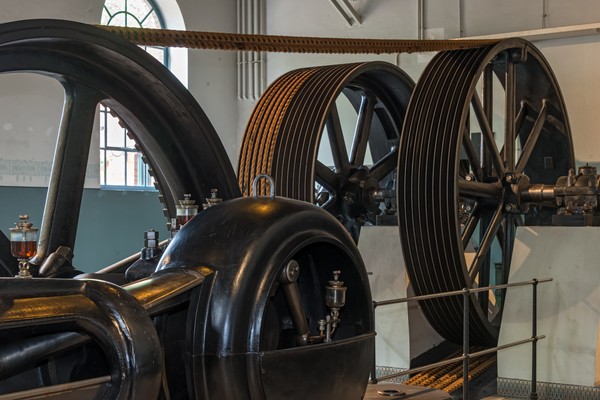
For this is where the heart of the factory lies: the steam engine. Visitors were guided here, and the wealth of surviving photographs bears witness to the special attention paid to the ‘power station’. The museum’s engine room is accordingly furnished in a manner befitting its status.
Today, the steam engine is set in motion by an electric motor: via ropes, it transmits the energy to the transmission system in the weaving hall.
Workshop
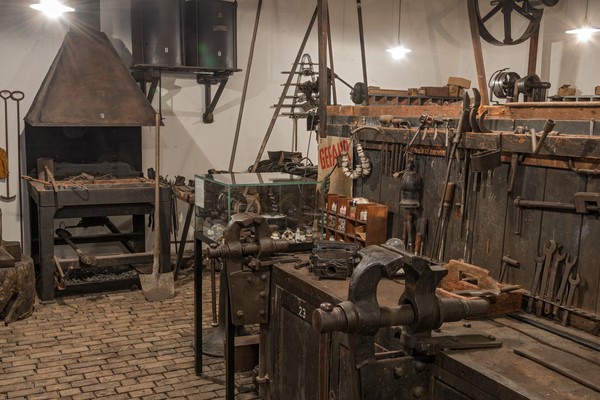
The workshop was used for the maintenance and repair of the machinery and the entire factory. In addition to repairs, new designs and technical improvements were also developed here. The workshop had the specific task of making the factory as independent as possible from external services. As is customary, the museum factory’s workshop is housed in a room in the immediate vicinity of the boiler house and the engine house, a space which, due to its poor lighting conditions, would not be suitable for other purposes. One enters the workshop through a door from the former Lühl weaving mill in Gemen, where it once provided access to the boiler house dating from 1894.
Workers’ Cottage
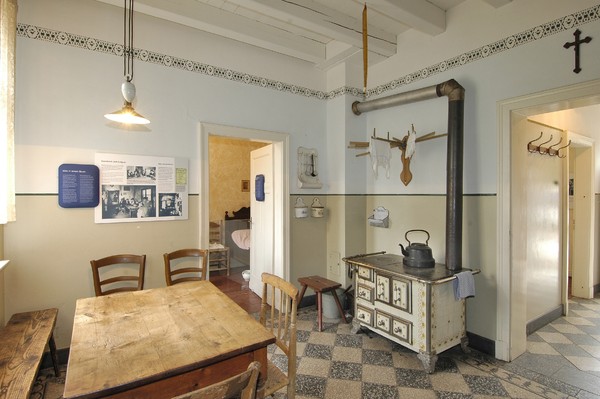
Built according to old plans and fully furnished, this workers’ cottage – complete with a cultivated vegetable garden and small livestock – offers a glimpse into the lives of textile workers in the Münsterland region during the era of industrialisation. We have recreated the kitchen-diner, the ‘Gute Stube’ (parlour), the bedrooms, as well as the storeroom and laundry room for you in our workers’ cottage.
As you walk through the house, you will gain an insight into the living environment of a textile worker’s family around 1920. The cultivated kitchen garden, complete with chickens and rabbits, gives an idea of just how much work the textile workers had to do even after finishing their shift at the factory in order to make ends meet.
In the left-hand section of the workers’ house, the themes of nutrition, hygiene, energy, clothing and home textiles are presented in separate exhibition areas. A laid table sets the scene for visitors to explore the theme of nutrition, both in the past and today. Historical everyday textiles such as work trousers and aprons are displayed on the upper floor alongside embroidered sample cloths. Patched duvet covers and bed sheets reveal much about historical everyday life, which was characterised by scarcity. Only by making things herself – whether by sewing or knitting – could a housewife ensure her family’s supply of textiles.
Guided tours
Find out more about our guided tours of the weaving mill.
Please note: These open tours are not available to groups.